

UK Manufacturing Faces £48 Billion Language Skills Gap as 2026 Workforce Challenges Mount, Says EdTech Expert

Language Training That Moves Business Forward
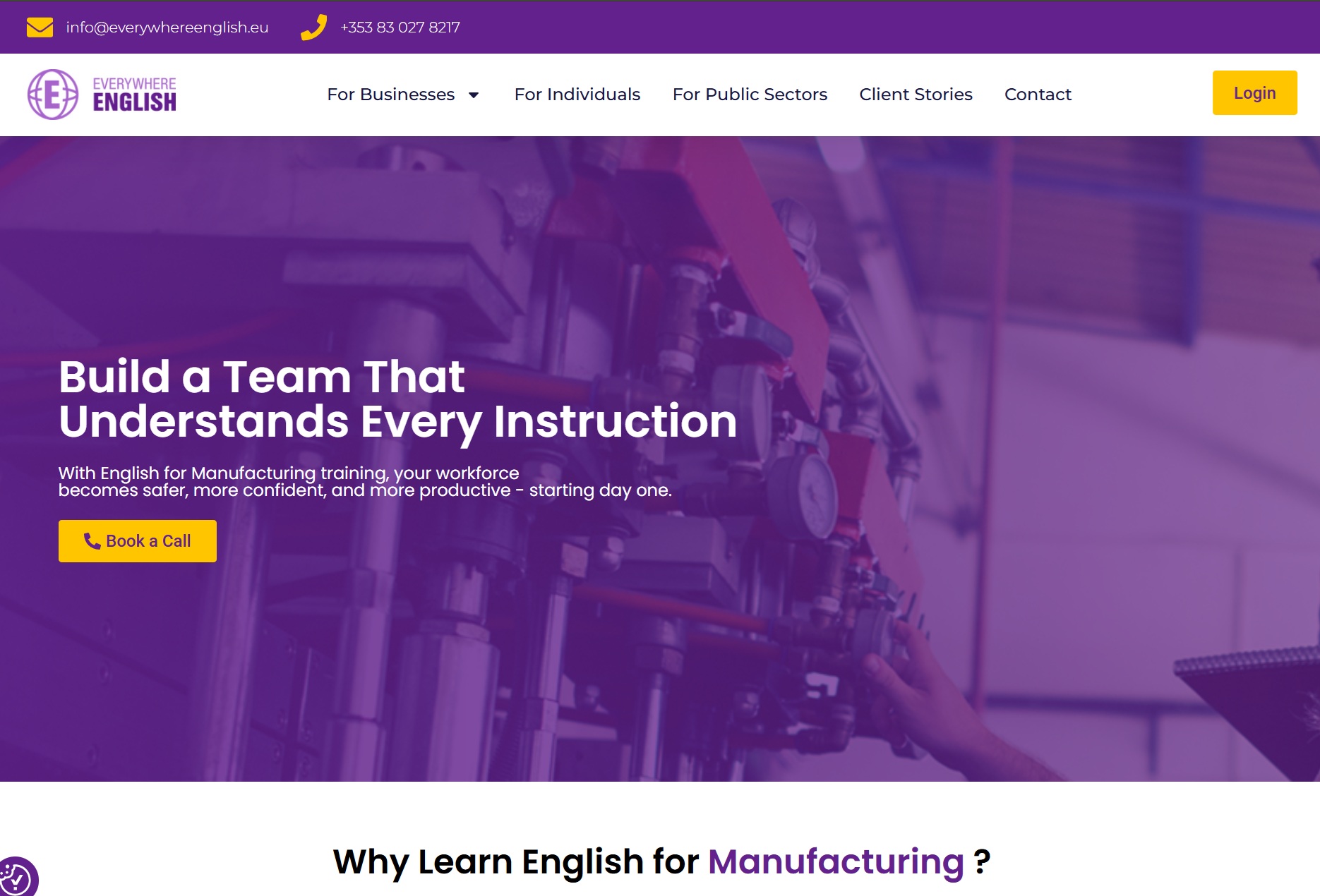
Build a Team That Understand Learning English In Manufacturing
Everywhere English founder shares five critical strategies for UK and Irish manufacturers tackling workplace communication barriers in the year ahead
Founded in 2021, Everywhere English specialises in business English training for manufacturing, hospitality, and logistics companies across the UK and Ireland. The company combines live online lessons with self-study resources, delivering industry-specific language programmes designed for shift workers and production teams. With the global business English market projected to reach £11.7 billion by 2028 according to Meticulous Research, and UK manufacturers increasingly reliant on multilingual workforces, the demand for effective workplace language solutions has never been greater.
Kate Popova of Everywhere English, believes that 2026 represents a turning point for how British and Irish businesses approach workforce communication.
"The numbers speak for themselves. When three-quarters of your non-native English speaking workforce actively avoid using English at work, you have a productivity problem, a safety problem, and ultimately a profitability problem," says Popova. "The companies that will thrive in 2026 are those that recognise language training as operational infrastructure, not a nice-to-have perk. Every miscommunication on a factory floor, every confused instruction in a warehouse, every lost customer in hospitality represents real money walking out the door."
The Hidden Cost of Workplace Language Barriers
Research from Mayflower College surveying 1,000 non-native English speakers found that 88 percent find it more difficult to communicate with native English speakers than with fellow non-native speakers. This communication friction creates bottlenecks throughout manufacturing operations, from shift handovers to quality control processes to health and safety compliance.
The challenge extends beyond simple comprehension. Studies published by AllTalk Training reveal that over 60 percent of non-native English speakers working in Ireland feel they must work harder than their native-speaking colleagues to progress in the workplace. Additionally, 43 percent report feeling excluded at work due to language or cultural differences, while 42 percent believe their opinions and ideas are not taken as seriously as those of native English speakers.
These statistics point to a workforce engagement crisis hiding beneath the surface of many manufacturing operations. When employees feel excluded or undervalued due to language barriers, turnover increases, institutional knowledge disappears, and recruitment costs escalate.
The manufacturing sector faces particular pressure due to the nature of its workforce composition. Post-Brexit immigration policy changes have reduced the flow of EU workers while simultaneously highlighting the need to develop and retain existing multilingual employees. Research from Aston University demonstrates that companies investing in language training for existing staff see measurable improvements in business performance, yet many organisations continue to underinvest in this area.
Why Traditional Approaches Fall Short
The business English training industry has historically failed manufacturing and industrial clients, according to Popova. Generic language courses designed for office environments do not address the specific vocabulary, safety terminology, and communication contexts that production workers encounter daily.
"A forklift operator in a Belfast warehouse needs different English skills than a marketing executive in London," explains Popova. "Traditional business English programmes teach presentation skills and email etiquette while ignoring the critical terminology around machinery operation, hazard communication, and shift coordination that actually keeps people safe and productive."
Everywhere English has developed sector-specific curricula addressing the distinct communication requirements of manufacturing, hospitality, and logistics environments. This approach recognises that effective workplace language training must align with the actual tasks, risks, and interactions employees face in their roles.
The completion rate challenge further illustrates the failure of conventional approaches. Industry data indicates that the average completion rate for business English learning courses sits at just 12 percent. This poor engagement stems from programmes that fail to accommodate shift patterns, lack relevance to daily work tasks, and provide no meaningful progress tracking for employers.
Five Strategies for Manufacturing Leaders in 2026
Based on extensive work with manufacturing clients across the UK and Ireland, Everywhere English has identified five critical strategies for companies serious about addressing workforce language barriers in 2026.
The first strategy involves prioritising health and safety communication above all else. Manufacturing environments present genuine physical risks, and miscommunication about hazards, procedures, or emergency protocols can result in injuries or fatalities. Language training programmes should begin with safety-critical vocabulary and expand outward from this foundation. Companies report that focusing initial training on safety terminology delivers immediate operational benefits while building employee confidence for broader language development.
The second strategy requires implementing flexible scheduling that respects shift patterns. Production workers cannot attend traditional daytime classes, and expecting employees to complete training during personal time leads to the dismal completion rates plaguing the industry. Effective programmes offer sessions before or after shifts, during scheduled breaks, or through asynchronous learning modules accessible around the clock. The hybrid model combining live instruction with self-paced study materials allows workers to maintain momentum without disrupting production schedules.
The third strategy demands sector-specific vocabulary training rather than generic business English. Manufacturing vocabulary spans machinery terminology, quality control processes, maintenance procedures, inventory management, and supply chain communication. Hospitality requires guest interaction language, complaint handling, and service recovery terminology. Logistics encompasses routing, documentation, customs, and delivery coordination language. Programmes that address these specific contexts deliver faster results and higher engagement than one-size-fits-all approaches.
The fourth strategy emphasises measurable outcomes and transparent reporting for HR and operations managers. Training investments require justification, particularly during economically uncertain periods. Language programmes must provide clear metrics demonstrating learner progress, attendance tracking, and performance improvement data. This transparency enables HR teams to demonstrate return on investment to senior leadership while identifying employees who may need additional support.
The fifth strategy focuses on building sustainable internal communication systems rather than treating language training as a one-time intervention. Companies achieving the strongest results integrate language development into their broader learning and development infrastructure, creating pathways for continued improvement and career progression. This approach transforms language training from a remedial measure into a genuine employee benefit that supports retention and advancement.
The Northern Ireland and Cross-Border Opportunity
Northern Ireland presents a unique opportunity for manufacturing companies seeking to strengthen workforce communication capabilities. The region's position bridging UK and Irish markets creates particular demand for employees comfortable operating across both jurisdictions.
Research conducted for Everywhere English's cross-border expansion strategy identified that thousands of professionals search monthly for business English training solutions in the UK, yet many regions remain underserved by specialist providers. Manufacturing clusters in Northern Ireland, the Midlands, and northern England represent significant untapped demand for workplace language programmes tailored to industrial contexts.
The InterTrade Ireland Trade Export Pathway programme has supported Everywhere English's expansion into Northern Ireland markets, recognising the value of improved workforce communication for cross-border business development. Companies operating across the Irish border face additional communication complexity, with employees potentially interacting with customers, suppliers, and regulators in both jurisdictions.
Technology and the Future of Workplace Language Training
The evolution of workplace language training increasingly relies on technology to deliver personalised, accessible, and measurable learning experiences. Modern platforms combine live instruction with algorithmic progress tracking, enabling programmes to adapt to individual learner needs while providing employers with real-time visibility into training outcomes.
Everywhere English employs a data-driven approach utilising tailored materials, interactive peer-learning solutions, and progress forecasting to maximise learner engagement and outcomes. This technology infrastructure proves particularly valuable for multi-site manufacturing operations where consistent training delivery across locations presents logistical challenges.
The rise of remote and hybrid work models across administrative functions has also normalised online learning for many employees, reducing resistance to digital training delivery. Workers who might have been sceptical of online language instruction three years ago now recognise the convenience and effectiveness of well-designed digital programmes.
Looking forward, artificial intelligence and machine learning will further transform workplace language training by enabling more sophisticated personalisation, pronunciation feedback, and contextual learning experiences. However, the human element remains essential, particularly for building speaking confidence and addressing the nuanced communication skills that manufacturing environments demand.
The Business Case for Investment
Manufacturing leaders evaluating language training investments in 2026 should consider both the direct costs of communication failures and the opportunity costs of workforce underperformance. When 97 percent of employees with employment barriers cite English skills as a hindrance, according to workforce participation research, the scope of potential improvement becomes clear.
Direct cost savings emerge from reduced workplace accidents, lower defect rates, decreased customer complaints, and improved operational efficiency. Indirect benefits include higher employee retention, stronger team cohesion, improved customer service, and expanded capacity for employees to take on broader responsibilities.
The most compelling business cases come from companies that track specific metrics before and after training implementation. Measuring indicators such as safety incident rates, quality control rejections, customer satisfaction scores, and employee turnover provides concrete evidence of training impact that justifies continued investment.
Frequently Asked Questions About Workplace English Training
Manufacturers and industrial companies considering workplace English training programmes commonly raise similar questions. The following addresses the most frequent concerns from HR managers and operations directors exploring language training solutions.
How long does it take to see measurable improvement in employee English skills?
Structured programmes typically deliver noticeable improvements within 12 weeks. The timeline varies based on starting proficiency levels, training intensity, and how closely programme content aligns with actual job tasks. Companies prioritising safety-critical vocabulary often observe immediate operational benefits as employees gain confidence with essential terminology.
What is the typical cost per employee for business English training?
Costs vary significantly based on programme structure, group sizes, and training intensity. Subscription-based models starting around £80 per employee monthly for programmes including live lessons and self-study access represent the more affordable end of the market. Premium providers and intensive one-to-one programmes command higher rates. Companies should evaluate cost against completion rates and measurable outcomes rather than price alone.
How do you accommodate shift workers who cannot attend standard training times?
Effective programmes offer flexible scheduling including early morning, evening, and weekend sessions alongside asynchronous learning materials accessible around the clock. The hybrid model combining scheduled live lessons with self-paced study enables shift workers to maintain consistent progress without requiring schedule changes that disrupt operations.
Can training be customised for our specific industry and workplace vocabulary?
Specialist providers develop sector-specific curricula addressing the distinct terminology and communication contexts of different industries. Manufacturing programmes cover machinery operation, safety protocols, quality control, and supply chain communication. Hospitality programmes address guest interaction, complaint handling, and service delivery. Generic business English courses rarely deliver the same engagement or outcomes as industry-tailored approaches.
How do we measure return on investment from language training?
Key metrics include training completion rates, employee proficiency improvements measured through assessments, safety incident trends, quality control performance, customer satisfaction scores, and employee retention rates. Providers offering transparent reporting dashboards enable HR teams to demonstrate training value to senior leadership with concrete data.
What if employees have very low starting English proficiency levels?
Quality programmes accommodate learners across the proficiency spectrum, from basic conversational skills through advanced business communication. Initial assessments establish baseline capabilities and inform appropriate placement. Programmes designed for manufacturing environments expect significant variation in starting levels and structure content accordingly.
Is online training as effective as in-person classroom instruction?
Research and client outcomes consistently demonstrate that well-designed online programmes match or exceed traditional classroom effectiveness, particularly for working professionals. Online delivery eliminates commuting time, enables flexible scheduling, and provides access to recorded materials for revision. The combination of live instruction for speaking practice and interaction with self-paced study for reinforcement maximises learning efficiency.
How do we get buy-in from employees who may be reluctant to participate?
Successful programmes frame language training as a benefit and career development opportunity rather than remedial intervention. Emphasising the practical skills employees will gain, the flexibility of training delivery, and the company's investment in their success builds positive engagement. Early wins with safety vocabulary and immediate job-relevant communication skills demonstrate value quickly.
A Call to Action for 2026
As UK and Irish manufacturers plan their workforce development priorities for 2026, language training deserves serious consideration alongside technical skills programmes and leadership development initiatives. The economic cost of inaction continues mounting while competitor companies gain advantage through more effective workforce communication.
Everywhere English invites HR managers, learning and development professionals, and operations directors to assess their current workforce communication challenges and explore how targeted language training might address productivity, safety, and retention goals. The company offers initial consultations and English level assessments to help organisations understand their specific needs and potential improvement pathways.
The £48 billion annual cost of language barriers to the UK economy represents both a challenge and an opportunity. Companies taking decisive action to address workforce communication in 2026 position themselves for competitive advantage while those delaying continue absorbing the hidden costs of miscommunication, disengagement, and preventable errors.
For more information about workplace English training programmes for manufacturing, hospitality, and logistics companies, visit Everywhere English online or contact the team directly to discuss specific organisational requirements.
Kate Popova
Everywhere English
email us here
Visit us on social media:
Instagram
TikTok
Everywhere English | A Demo of our Platform: What we do
Legal Disclaimer:
EIN Presswire provides this news content "as is" without warranty of any kind. We do not accept any responsibility or liability for the accuracy, content, images, videos, licenses, completeness, legality, or reliability of the information contained in this article. If you have any complaints or copyright issues related to this article, kindly contact the author above.
